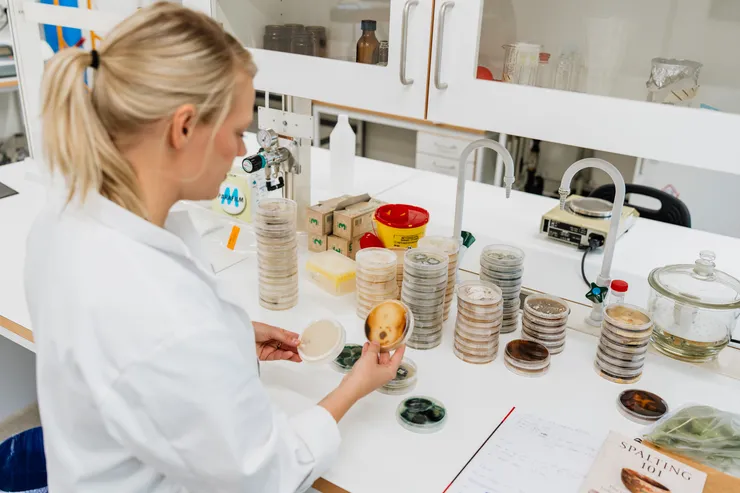
Our dear Hub member, Amanda Selinder, was recently interviewed by Linköping University, expanding on her incredible biological artwork that will take place at Campus Valla. Below is an excerpt from the interview, find the full interview here.
Amanda Selinder is fascinated by the mushroom species. Especially perhaps the green elf cup (Chlorociboria aeruginascens), which actually looks like a small blue-green bowl. Her interest and fascination arose when, studying at the Academy of Art and Design (HDK) in Gothenburg, she discovered the art form bioart, through an exchange with an art school in the United States.
“That school had a lab with its own biologist to assist students. I wanted to be that biologist.”
So instead of going home and studying the Master of Fine Arts programme, which was the idea, she instead did a BSc in biology at Uppsala.
“A good decision in retrospect, but at the time everyone probably thought I was a little crazy. And what’s fun with biology in art is that you reach an additional audience: mushroom nerds.”
High stumps and fungal communities
A project where biology and art come together; the artistic design of Corson, seemed tailored for a bioartist like Amanda Selinder. And her proposal won the contract. When Amanda walked around on campus thinking about her assignment, the many high stumps caught her curiosity. What had happened here?
“I spent a summer researching, reading about elm disease, ash dieback disease, about the fungus that in symbiosis with the elm bark beetle spreads elm disease. About the fungal community that is found inside leaves’ cell tissue and which is one of several contributing factors to the survival of some trees.”
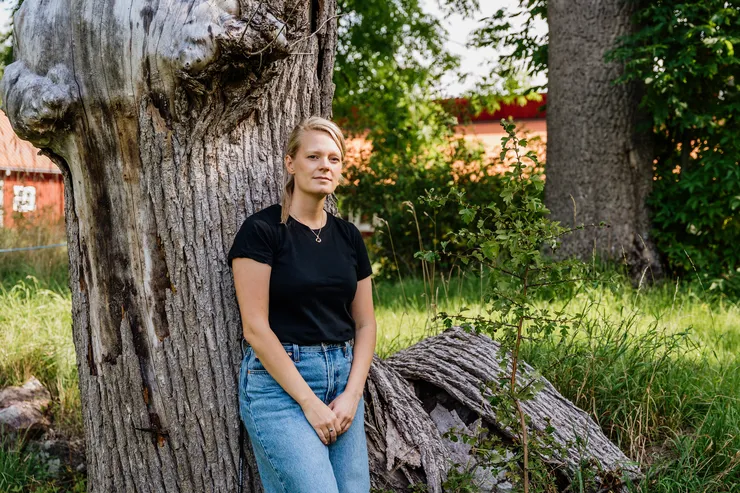
Photos: Jenny Widén
Interview by: Elisabet Wahrby